


The USS Gerald R. Ford cost about $13 billion, the most the U.S. Navy had ever spent on a single warship when it was delivered. It is also the first American carrier to throw jets into the air with electromagnets instead of steam, and its latest deployment lasted 326 days, the longest for a U.S. carrier since the Vietnam War.
The short version of how it got there: the ship showed up years late, was handed over without working bomb elevators, and then spent most of two long deployments in the middle of real crises.
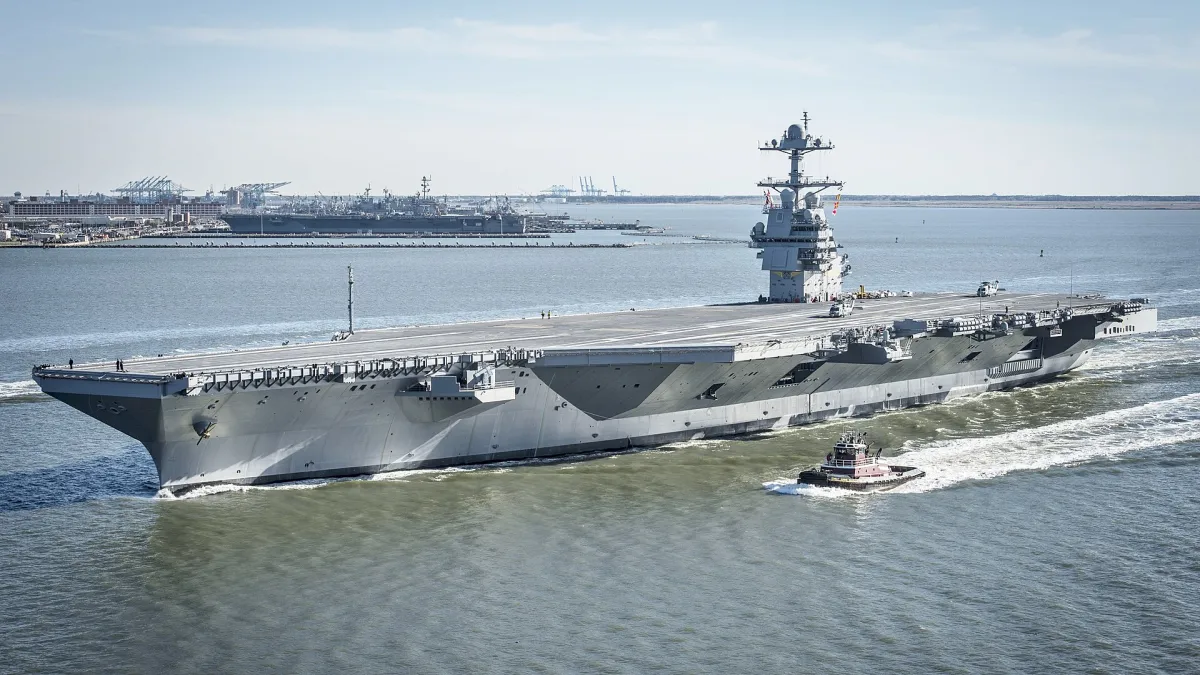
What $13 billion buys
The Navy's budget estimate for building the ship was $12,964.0 million, according to a Feb. 1, 2019, Congressional Research Service report. In 2006, Congress had capped the cost at $10.5 billion, plus adjustments for inflation and other factors. By 2018 the cap had been raised to $13.0 billion, and the program still needed an extra $1.39 billion in cost-to-complete funding.
| Commissioned | July 22, 2017 |
|---|---|
| Length | 1,106 feet (337 m) |
| Displacement | About 100,000 tons, fully loaded |
| Reactors | Two A1B nuclear reactors |
| Top speed | Over 30 knots (35 mph) |
| Aircraft | 75 or more |
| Crew | About 2,600 ship's company; 4,539 with air wing and staff |
| Cost | About $13.0 billion to build |
Magnets instead of steam
For more than 50 years, Navy carriers have launched jets with steam catapults. The Ford's Electromagnetic Aircraft Launch System, or EMALS, swaps the steam piston for a linear induction motor. The pitch was a smoother ride for the aircraft and a faster tempo: the Navy set a requirement of 160 sorties a day for 30 days, a 33 percent improvement over a Nimitz-class carrier, with a four-day surge of 270.
Then came the test numbers. From November 2019 to September 2020, testers logged 3,975 launches and recoveries. EMALS averaged 181 launches between failures serious enough to scrub a mission. The requirement was 4,166. The new arresting gear that catches landing jets managed just 48 recoveries between failures. Bloomberg News reported the Pentagon's findings in January 2021.
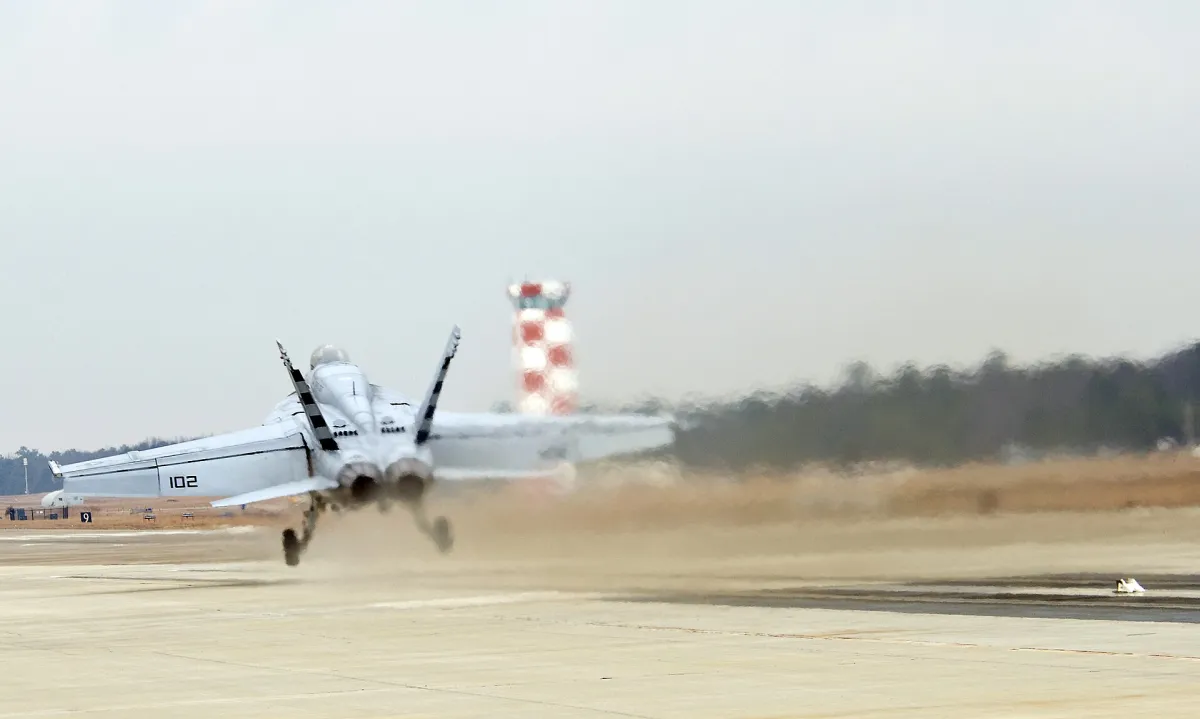
The Navy cleared EMALS for every type of naval aircraft in February 2020, and the ship has kept flying. On its 2023-24 deployment the strike group flew 10,396 sorties.
Fewer sailors, three times the electricity
The Ford was designed around electricity. The Navy told the Senate in 2015 that its propulsion plant has three times the electrical generating capacity of a Nimitz-class carrier's, power that EMALS and a new radar need.
The other promise was people. The Navy planned to cut 663 jobs from the ship's crew, nearly 1,200 counting the air wing, and to save $4 billion per ship over 50 years. Military Times reported in 2014 that the ship's company would be about 2,600 sailors, roughly 600 fewer than on a Nimitz-class carrier. The old 180-person berthing areas gave way to rooms of about 40 racks.
Those are design goals, not measured savings.
Late, over budget and missing its bomb elevators
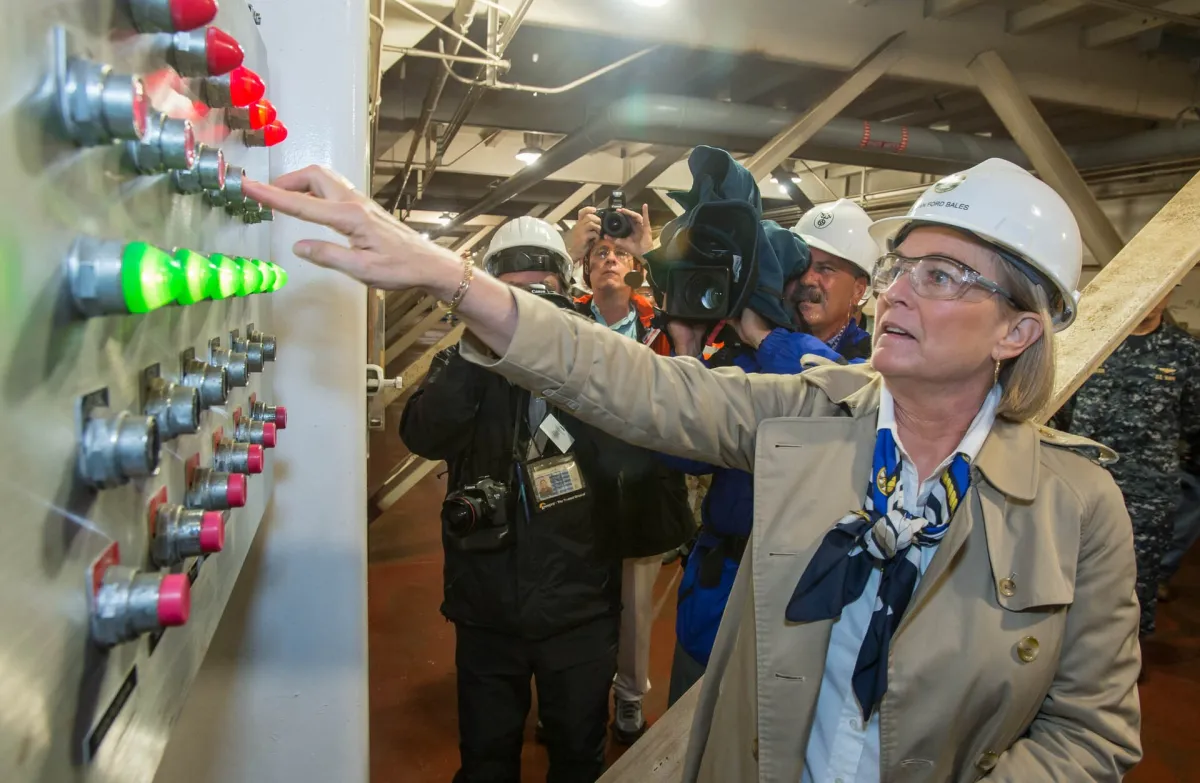
Steel was first cut in 2005. The carrier floated out of its dry dock on Oct. 11, 2013, with the ship's sponsor, Susan Ford Bales, starting the flooding. Delivery had been planned for 2015. The Navy took the ship on May 31, 2017.
It arrived without a key piece. Bloomberg reported in November 2018 that the Navy's costliest warship was delivered without the 11 magnetic elevators that lift bombs from the magazines to the flight deck. Four times since 2015, the elevators had made unsafe, uncommanded movements. Navy Secretary Richard Spencer called the elevator "our Achilles heel."
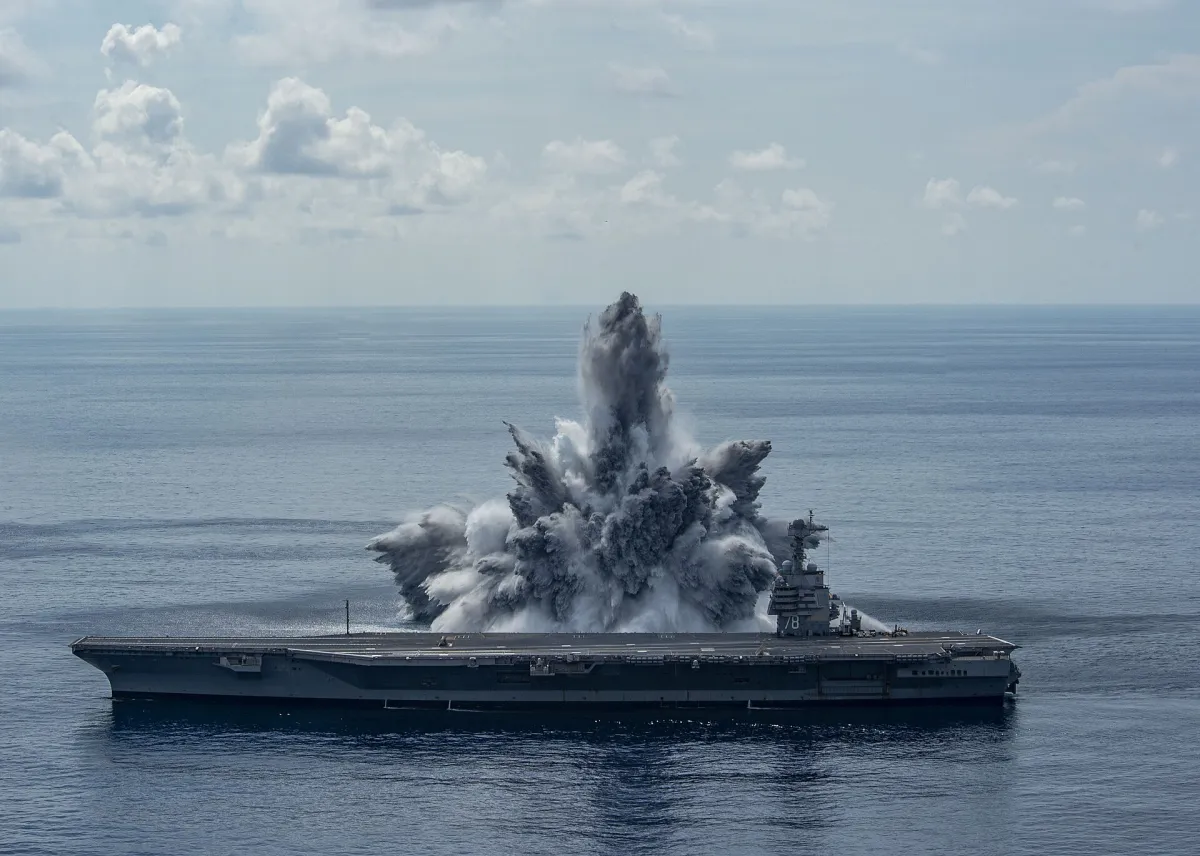
To prove the hull could take a beating, the Navy set off three powerful underwater explosions near it in 2021. The last came on Aug. 8.
Two deployments, one record
The Ford's first full deployment began in May 2023. After Hamas attacked Israel on Oct. 7, the strike group moved to the Mediterranean, and the trip was stretched by 76 days. It returned to Norfolk on Jan. 17, 2024, after 239 days away: 10,396 sorties, 17,826 flight hours and 83,476 nautical miles, about 96,000 miles, or nearly four trips around the Earth.
The second deployment left Norfolk on June 24, 2025. In October the Ford was rerouted to the Caribbean for the largest U.S. naval buildup there in generations, and it took part in the January operation that captured Venezuelan President Nicolás Maduro. It then joined the opening days of the Iran war from the Mediterranean and moved into the Red Sea in early March, according to the Associated Press.
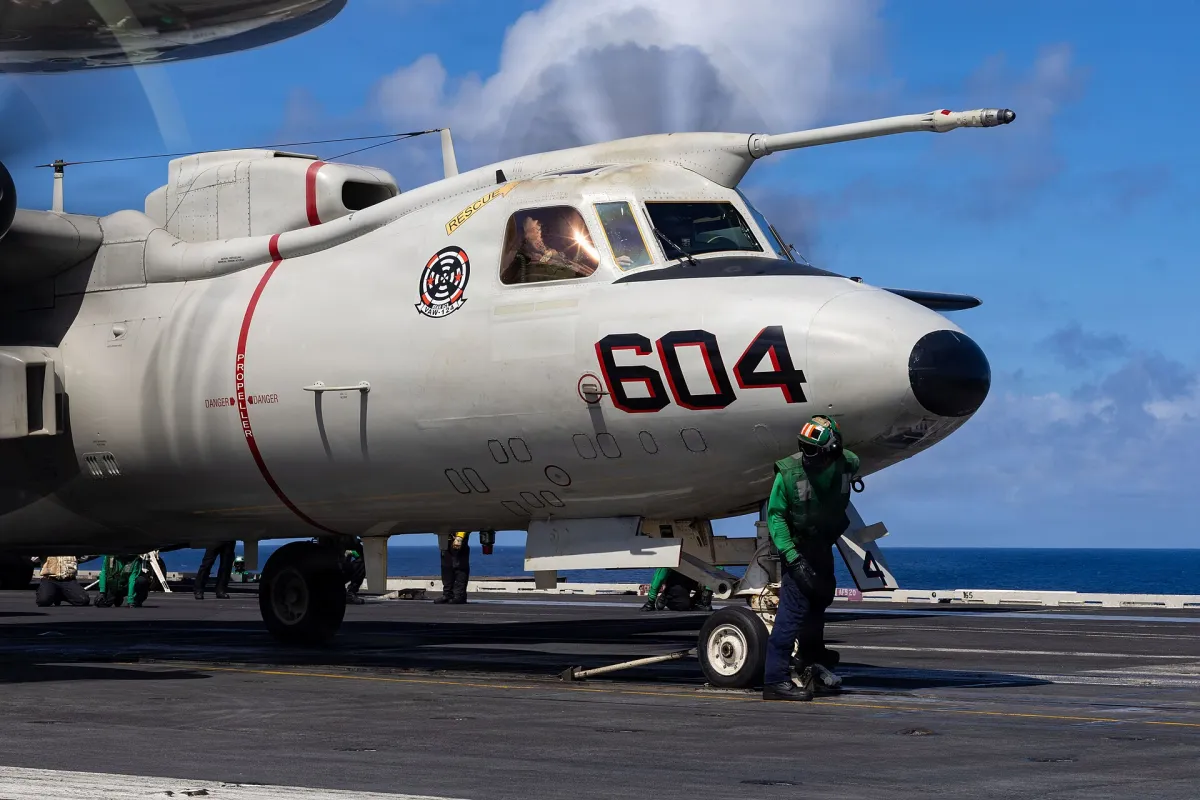
On March 12, 2026, a fire broke out in the main laundry. It took about 30 hours to put out. The Navy said it was not combat related. Reports differ on how many sailors lost their bunks, from about 100 to more than 600. The Ford pulled into Souda Bay, Crete, on March 23 for repairs.
It reached Norfolk on May 16, 2026, after 326 days at sea. By the AP's count, only USS Midway in 1973 (332 days) and USS Coral Sea in 1965 (329 days) stayed out longer. USS Nimitz was away 341 days in 2020-21, but that total included weeks of COVID-19 isolation ashore.
So is the Ford a triumph or a money pit? The record supports both. The magnets, the elevators and the new reactors blew up the schedule and the bill. But once the ship was at sea, it went where it was sent: the Caribbean, the Mediterranean, the Red Sea.
The next test is wear. The AP noted concerns about the strain a 326-day cruise puts on the crew and the ship. And the Navy chose in 2017 to keep EMALS and the arresting gear on the first three Ford-class carriers, so whatever the Ford learns will follow its sisters.
Sources
- Congressional Research Service, Navy Ford (CVN-78) Class Aircraft Carrier Program, RS20643, Feb. 1, 2019
- U.S. Senate Armed Services Committee hearing on the Ford-class program, Oct. 1, 2015 (GPO)
- Task & Purpose, Pentagon test findings on EMALS and arresting gear
- Military Times, crew size and berthing on the Ford (Oct. 27, 2014)
- U.S. Navy via DVIDS, Ford Carrier Strike Group returns from deployment (Jan. 2024)
- Military Times, Ford returns home after 8-month deployment (Jan. 18, 2024)
- Associated Press via PBS NewsHour, Ford returns after record deployment (May 16, 2026)
- Military Times, Ford docks in Greece after fire (March 23, 2026)
- Task & Purpose, Ford fire and repairs (March 2026)
- Wikipedia, USS Gerald R. Ford (ship dimensions, reactors and key dates)